Showing posts with label theatre. Show all posts

Thursday, November 3, 2016

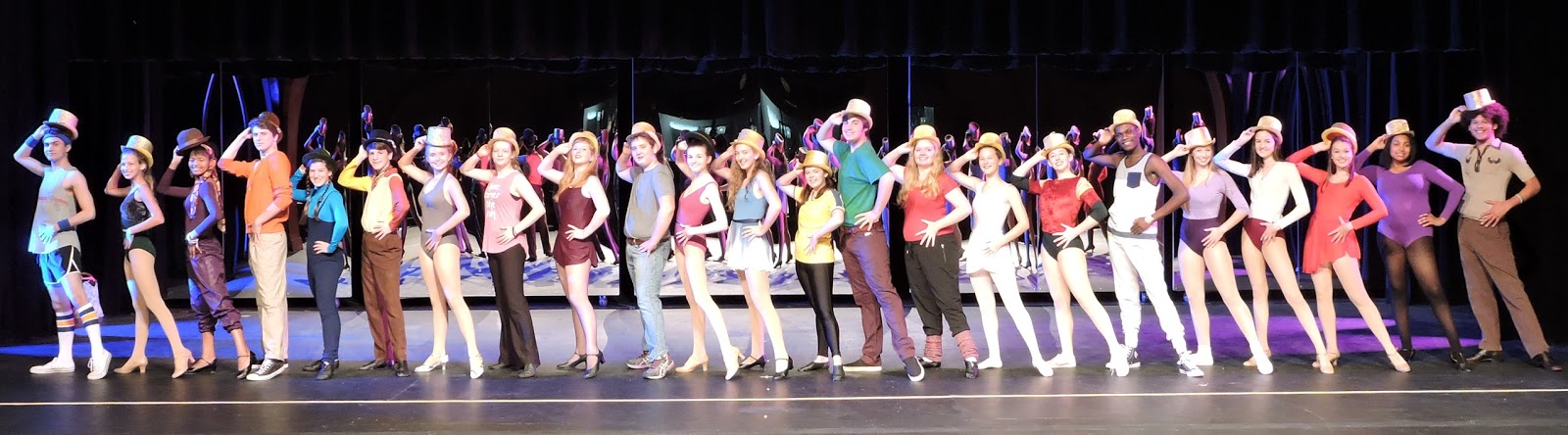
Behind the Scenes of "A Chorus Line"


As you glance across the room the blinding lights create a hazy vision of the hundred or so people sitting in front of you, each pair of eyes staring and examining your every move, creating the strangling feeling in your stomach telling you, “welcome to the spotlight.” You’ve been rehearsing this very moment for months, so what could possibly go wrong? There’s no need to be nervous … but then again, there is. You could miss a step, you could sing the wrong line, you could get a little nervous tummy ache and, well, you know the rest. Either way, this is it. An audience awaits, the music is ready, and the show is about to begin. This is, A Chorus Line.

For the past two months, 24 Greensboro Day Upper school students have been rehearsing their next up-and-coming musical, A Chorus Line. For those of us uneducated on the musical itself, A Chorus Line follows 16 individual actors wishing to “make it” on Broadway. However, not as Broadway’s next top-shot star but as the individuals who have no character name and are simply used for their voice and dance moves. These 16 actors are trying to earn a spot on Broadway’s chorus line.

I attended a rehearsal of the show this past Thursday and I can truly say that this cast may be one of the most hardworking casts GDS has ever had. The work that they put into the musical is significant, and they have spent long nights perfecting the very smallest details. We get to see the final product of the show as they stand on stage, but behind the scenes, they’re also students, high school students who are balancing both their school work and their work in the show. Whether they are piled with AP U.S. History work from Mr. Piacenza, studying for an upcoming quiz in SeƱora Swinton’s Spanish 2, or attempting to finish a load of math homework from Mr. Ross, all of our students show an exemplary ability to figure out how to best handle it all.

Favorite scenes for the cast
Avery Blue '17 (Zach):
My favorite scene is probably “One,” which is basically a number where everybody dances and sings and I like it because it’s where everybody comes together and it sounds fantastic and it shows all the hard work. Everybody is able to show off their practice; it’s just really cool.”

Morgan Winstead '18 (Judy Turner):
“There is a series of songs that pile into one big song called “the Montage.” There’s one part where its Judy’s turn to talk and she runs down and she starts spewing out everything that comes to the top of her head. She talks about how her little sister was a brat and so she decided to shave her sister’s hair off, she talks about how her mom embarrassed her, and that she’s seen a dead body—and that’s all she says—she only says, “that was the first time I ever saw a dead body.” It’s just stuff like that, it’s random, and that’s the best part of the show for me.

Desmond McIntyre '17 (Richie Walters):
“Personally, I love the Montage. It’s really long, but it’s so much fun and it will blow your mind! Also, the ending number, “Bow,” is jaw dropping. You will definitely be in tears, have chills, everything! I love the song and I love the dance.”

Why should people come to the show?
Avery Blue '17 (Zach):
“I guarantee you’ll be able to find somebody that you can connect with on one level or another. You can come out and enjoy the music and the dancing because it’s fantastic. Plus, it’s just a good night to have with your friends and family.”

Morgan Winstead '18 (Judy Turner):
“All of the characters are really relatable and even though not everyone is playing a character that is similar to them, it still feels really human. With shows that we’ve done in the past, it’s felt like that, but I don’t think anyone’s ever felt more connected to their character than we have in A Chorus Line which is going to make it really interesting.”

Hayley Rafkin '17 (Val Clark):
“This show is different than any show we’ve done before. It’s more of a one on one experience and more personal because we interact and make connections with the audience. These aren’t necessarily fictional characters; we’re real people that are portraying a real audience process. So this is more of a story of people rather than characters.”

Laura Tutterow '17 (Cassie Ferguson):
"People should come out because as a senior, it’s very sentimental moment for me and we’ve all been working extremely hard!"

Davis Dunham '17 (Paul San Marco):
"This is definitely the most dancing we’ve ever had to do in a show before. The opening number is completely dancing and its ten minutes long. We dance at the Ballet, then we dance in the Montage but that’s a twenty minute long song. It’s so much dancing, but we’ve all worked extremely hard and it’s going to be an amazing performance.”

Lindsey Cooke '17 (Stage Manager):
“I’m the stage manager for A Chorus Line and I have been really impressed with this rehearsal process so far. This show is a lot different than ones we’ve done before, it’s the most dance-based show that’s been done since I’ve been in high school. They’ve all worked extremely hard and I know the audience is going to be able to see it!”

A Chorus Line runs November 10-13, 2016 at Greensboro Day School's Sloan Theatre. Tickets are available at greensboroday.org/tickets.

Thursday, October 23, 2014

THEATRE at GREENSBORO DAY SCHOOL: NOT JUST A 3-DAY PRESENTATION

The Upper School production of “The Addams Family” will soon come to the Sloan Theatre stage. November 6-9 will undoubtedly bring us another showcase of our talented and dedicated students.

At Greensboro Day School we have committed significant resources to provide a remarkable theatre program for the campus and the Greensboro community. The 600-seat Sloan Theatre is a tremendous facility far surpassing those at area public or independent schools. We believe our students benefit tremendously from participation in our productions. Thirty percent (30%) of our 1st-4th graders participate in our after-school theatre program. In Middle School 33%, and in Upper School 23% engage in our theatre program. Why would your child want to participate in theatre at any other school?

Theatre provides practice in memorization, the ability to think on your feet, problem-solving, performing under pressure, speaking in front of an audience, operating under a strict deadline, and many other areas. For potential employers or college admission committees looking for the perfect applicant, citing experience in these skills may be just the way you will stand out from the hordes of other promising applicants.

JUST THE FACTS
  • In one study, students involved in drama performance coursework or experience outscored non-arts students on the SAT by an average of 65 points in the verbal component and 34 points in the math component.(1)
  • Drama activities improve reading comprehension, and both verbal and non-verbal communication skills?
  • Drama helps to improve school attendance and reduce high school dropout rates.(2)
  • A Harris Poll revealed that 93% of the public believes that arts, including theatre, are vital to a well-rounded education. (3)
  • Drama can improve skills and academic performance in children and youth with learning disabilities.
DRAMA IMPROVES ACADEMIC PERFORMANCE
Numerous studies have demonstrated a correlation between drama involvement and academic achievement. In addition to having higher standardized test scores than their peers who do not experience the arts, student who participate in drama often experience improved reading comprehension, maintain better attendance records, and stay generally more engaged in school than their non-arts counterparts. Schools with arts-integrated programs, even in low-income areas, report high academic achievement.

DRAMA STUDENTS OUTPERFORM NON-ARTS PEERS ON SAT TESTS

The College Entrance Examination Board reported student scores from the Student Description Questionnaire indicating student involvement in various activities, including the arts. As compared to their peers with no arts coursework or involvement:
  • Students involved in drama performance scored an average of 65.5 points higher on the verbal component and 35.5 points higher in the math component of the SAT
  • Students who took courses in drama study or appreciation scored, on average, 55 points higher on verbal and 26 points higher on math than their non-arts classmates.
  • Students involved in drama performance outscored the national average SAT score by 35 points on the verbal portion and 24 points on the math section. 
READING COMPREHENSION
From learning to read to the in-depth study of Shakespearean literature, drama can play a significant role in the continual development of students’ reading comprehension skills. Studies indicate that not only do the performance of a story and a number of other drama activities in the classroom contribute to a student’s understanding of the work performed, but these experiences also help them to develop a better understanding of other works and of language and expression in general. The results below were gleaned from studies where educators and students alike noticed a difference when drama played a part in their classrooms.
  • A series of studies on the arts and education revealed a consistent causal link between performing texts in the classroom and the improvement of a variety of verbal skills, including especially significant increases in story recall and understanding of written material.
  • Performance of Shakespeare texts helps to improve students’ understanding of other complex texts including science and math material.
  • Drama can improve reading skills and comprehension better than other activities, including discussion.
BUILDING SELF-ESTEEM THROUGH DRAMA
In addition to building social and communication skills overall, involvement in drama courses and performance has been shown to improve students’ self-esteem as well as their confidence in their academic abilities.
  • High school students who are highly involved in drama demonstrate an elevated self-concept over those who are not involved.
  • Playwriting original works and dramatic presentation of existing works can help to build the self-esteem and communication skills of high school students.
  • The act of performing can help students and youth recognize their potential for success and improve their confidence.
Why do students put three, four, months or more into the production. Why do they do it? Why do schools commit resources to these events?

We believe theatre aids our students in a multitude of ways:
  1. Improvisation. The great thing about the stage is that when it’s live and you’re up in front of that audience anything can, and does, happen. Dropped lines, missed entrances, or malfunctioning props require you to improvise while maintaining your cool. Theatre teaches students how to focus, think quickly and make do while giving the impression that you’ve got it all under control. Later in life is will serve our students well when clients, airlines, coworkers, or technology wreak unexpected havoc at the worst possible moment. 
  2. Time Management. Academic work, travel soccer, activities in faith communities all continue when a student is engaged in a play production. The long hours of rehearsal force a student to manage their time at an early age. 
  3. Dealing with Very Different Human Beings. The theatrical community is a mash-up of interesting characters. It always has been. Theatre taught our students how to appreciate, understand and effectively communicate with a widely diverse group of human beings. 
  4. Doing Whatever Needs to Be Done. You have to learn to do it all. Light design, sound engineering, acting, directing, producing, marketing, PR, set design, set construction, ticket sales, budgeting, customer service, ushering, make-up, and costuming are all things in a production. 
  5. Hard work. Long hours, burnt fingers and a few brushes with tragedy are needed to get each and every show done. After the show the set is torn down, thrown out, and we get ready for the next production. C’est la vie. Later in life our students will have periods of time with unbelievable workloads in which there are sleepless nights, seemingly endless days and tireless work on projects that will be presented and then will be over. The report will be archived and onto the next project. C’est la vie. They learned how to do this as a theatre student. 
  6. Presentation Skills. Okay, it’s a no brainer but later in life our students will have to endure long training sessions or corporate presentations by boring, unprepared, incompetent or just plain awful presenters. Individuals who can stand up confidently in front of a group of people and capably, effectively communicate their message while even being motivating and a little entertaining are among the rarest individuals in the world. Being a theatre student helps our students be one of them. 
_____________________________________________________________________________

Information adapted from the aate.com (American Alliance for Theatre and Education) web site.

(1) Data for these reports were gathered by the Student Descriptive Questionnaire, a self-reported component of the SAT that gathers information about students' academic preparation, and reported by the College Entrance Examination Board. A table of average scores for arts involved students can be found at:http://www.menc.org/information/advocate/sat.html

(2) N. Barry, J. Taylor, and Kwalls, "The Role of the Fine and Performing Arts in High School Dropout Prevention,” Critical Links: Learning in the Arts and Student Achievement and Social Development, ed. Richard Deasy (Washington, DC: Arts Education Partnership, 2002) 74-75.

(3) Sandra S. Ruppert and the National Assembly of State Arts Agencies, Critical Evidence: How the Arts Benefit Student Achievement (Washington, DC: National Assembly of State Arts Agencies and the Arts Education Partnership, 2006).

Adapted from an article by Marguerite Happe.